

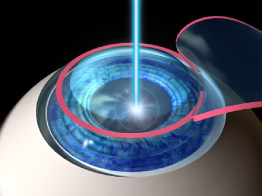
LASIK surgery is one of the well-known eye surgeries for people suffering from refractive errors. This surgery reduces the dependence of patient on corrective lenses used for treating eye sight diseases like hyper-metropia, myopia and astigmatism.
One of the foremost questions that arises when planning for LASIK is, “does insurance cover LASIK?” If yes, then the next question is, “How much is LASIK with insurance?” Unfortunately, the answer is that most of the insurance companies do not cover LASIK in their policy.
This is because, it is considered as a cosmetic surgery, rather than a medical need, which can be treated using lenses. However, large specialty unions cover LASIK as they dedicate monthly premium dollars to the insurance fund.
Usually, insurance covers most of the costs related to corrective lenses rather than laser treatment. If your insurer does not cover LASIK, the other option you can consider is the LASIK discount program, which can be offered by many insurance plans. This way, you can reduce the cost on your bill.
Any alternatives?
There is again an exception to vision plan in an insurance. If a unique situation arises such that only LASIK is the only option to correct the patient’s vision then, LASIK is considered to be medical surgery rather than just an elective or cosmetic surgery.
The exclusions include:
- LASIK for those who are incapable of wearing spectacles due to reasons like injury or disability
- If any previous eye surgery needs correction through LASIK surgery
- If the refractive errors are too severe such that LASIK is the only option
- Injuries that result in refractive errors, which can be corrected only by LASIK
Before you go sign an insurance policy, check with your insurer if there are any exceptions for LASIK. If you learn that you will be eligible for LASIK under any exclusion clause, you should know how to take the claim forward. Consult both the insurer and the physician to know what exactly the insurer needs from you to get the claim approved.
How costly is it without insurance?
LASIK is a high priced treatment and hence, most of the patients cannot afford it. Some hospitals like Bakersfield LASIK, California, make special payment arrangements so that the patient can make convenient and affordable payments for getting LASIK surgery done.
The arrangement of teaming up the patient with a trusted third party is done. The payment methods are generally similar to those made by credit cards. Hence, LASIK becomes a reality for most of the patients, rather than still being a dream.
Some of the big insurance companies like Davis Vision, Blue Cross Blue Shield and VSP, negotiate with hospitals that offer LASIK services to help its customers with a decent discount. Hence, the price tag you see for LASIK surgery is not what you will be paying. You might be eligible for insurance-based discounts for the LASIK treatment you are planning for. However, it is quite difficult to get the complete LASIK claim approved.
How much does LASIK eye surgery cost?

What factors influence LASIK eye surgery cost?

What is included in the cost of LASIK eye surgery?

Content Source - Lasik.com
Who can qualify for LASIK coverage
Though the insurance companies do not cover LASIK surgery in their policies, they do cover laser eye surgery for certain people. On the grounds of special preference, some people can get it approved. The eligibility is only for those who qualify the special preference that can be considered by the insurance company.
LASIK coverage is job based. If you serve Special Forces, especially those servicing in the Australian, Canadian and U.S. military, and if you meet particular vision requirements, the possibility of LASIK coverage can be high. However, you can be bound with restrictions like waiting period and surgery in a military facility.
Sometimes, insurance company might deny though you meet the exclusion clause. If you are denied of the claim, and if you are a civilian who acts, entertains or plays sports for your living, then you can file a case against the insurance company that your job demands you for LASIK surgery. However, you need to keep in mind that winning these type of cases is not an easy job. It can involve a lot of paper work and time investment.
Certain jobs demand safety requirement like police and firefighters. You might qualify for a LASIK. Also, certain medical conditions like severe eye dryness, allergies, contact lens intolerance etc. might demand for LASIK as you do not have any other option.
In such cases, you might qualify for LASIK coverage. The conditions need to be well documented during the claim. However, the insurance company can still deny the claim on the grounds of LASIK as a cosmetic surgery, meaning that they are unable to view the situation of LASIK surgery as a medical necessity.
If you do not qualify for any exclusion clause, then the last option to try for LASIK through insurance company is that, you need to be honest while approaching them. Remember that you are neither a soldier nor a performer. Therefore, the company has complete rights to deny your claim, and you cannot abuse them.
Experience of policy holders
According to David Mann, he was suffering from refracting error, because of which he was suggested to go for LASIK. When he approached the insurance company, his claim was denied saying that it was a cosmetic surgery.
However, he was treated as a member of a discount plan. Later, he developed infections from the LASIK procedure. This time, his claim was approved as it was a medical necessity. This clearly shows that it is quite difficult to get approval for a LASIK claim.
Conclusion
LASIK coverage through insurance companies is quite tough for approval. If you can show it as a medical necessity by making use of exclusion clauses, there are chances that your claim can be approved.
For this, you need to be very careful with the paper work.
 Laser Eye Surgery Is Amazing
 Longing To Throw-Away Your Glasses?






 Tips To Get Financing For Swimming Pool With Poor Credit
 Are There Dental Insurance With No Waiting Period Available?
 Does Life Insurance Cover Suicide? Find Out Now
 Does Insurance Cover LASIK?
 Does Dental Insurance Cover Implants?
 How Does Age and Policy Term Affects Life Insurance Rates?
 What Are The Main Advantages And Disadvantages Of Life Insurance?
 What Is SR-22 Insurance ?
 Are There Car Insurances With No Down Payment?
 Find Out The Best Inexpensive Car Insurances In San Antonio
 What Is Course Of Construction Insurance?
 What Is Peak Property And Casualty Insurance And What Does It Cover?
